
Consumer Consent for Biometric Insurance Data: Framework Guide
A practical consumer consent biometric insurance data framework for carriers building underwriting programs around biometric and health data.
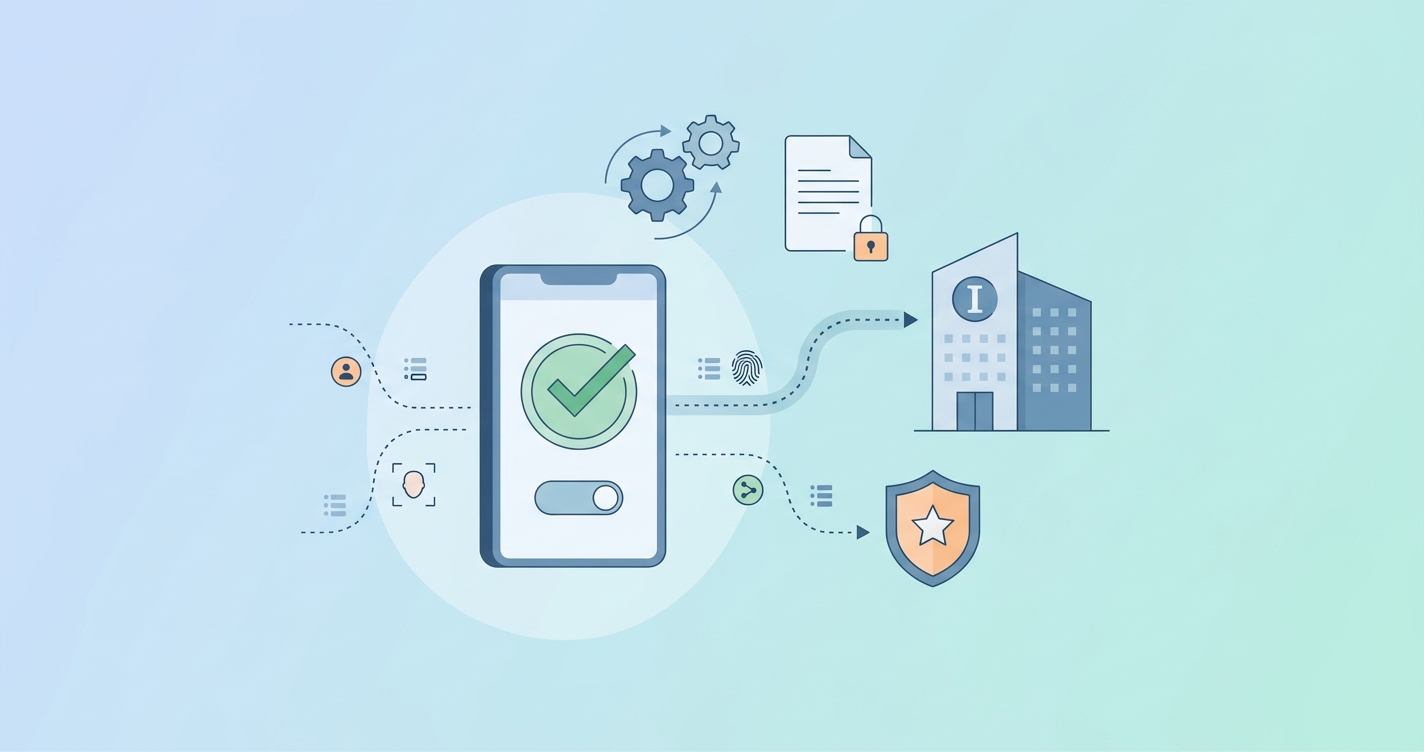
A consumer consent biometric insurance data framework has stopped being a policy appendix and turned into operating infrastructure. Carriers that collect face scans, voiceprints, photoplethysmography signals, or other health-adjacent biometrics now face a simple problem with expensive consequences: if consent language is vague, buried, or disconnected from downstream data use, the compliance risk does not stay in legal. It spills into underwriting governance, vendor oversight, reinsurance diligence, and market-conduct exams. For chief medical officers, reinsurance medical directors, and compliance teams, the real question is no longer whether consent matters. It is whether the consent record can travel with the data all the way through the underwriting chain.
"The My Health My Data Act was developed to protect a consumer's sensitive health data from being collected and shared without that consumer's consent." - Washington Attorney General's Office, FAQ on the My Health My Data Act
Analysis: what a consumer consent biometric insurance data framework has to cover
The cleanest way to think about a consumer consent biometric insurance data framework is to treat consent as a governed data object, not a one-time checkbox. That is where many insurance programs still go wrong. A disclosure may be collected at intake, but the organization cannot later prove which data type the applicant approved, whether algorithmic analysis was included, whether sharing with vendors or reinsurers was disclosed, or when the consent expired.
That gap matters because the legal baseline is getting stricter and more specific. Illinois' Biometric Information Privacy Act remains the best-known benchmark for written notice and informed consent. Texas and Washington have their own biometric or health-data rules. Washington's My Health My Data Act broadened the field further by covering health-related data outside HIPAA and by making private actions possible through the state's consumer-protection regime. In parallel, insurance regulators are building governance expectations around AI, external data, and unfair discrimination.
Michael Humphreys, Pennsylvania's insurance commissioner and chair of the NAIC Big Data and Artificial Intelligence Working Group, said in the NAIC's May 2025 release that the organization is now focused on "corporate governance, transparency, and consumer protection." That is a useful summary of the consent problem. Consent is not just a privacy artifact. It is evidence that governance, transparency, and data-use boundaries were defined before an underwriting model touched the file.
| Framework element | What the consumer should know | What the insurer should retain | Why regulators care |
|---|---|---|---|
| Data type disclosure | Whether the insurer collects face, video, voice, pulse, or other biometric/health-derived data | Versioned notice text tied to the application event | Proves the applicant was told what was being collected |
| Purpose limitation | Whether the data supports identity verification, underwriting review, fraud controls, or analytics | System-level mapping from consent text to actual workflow | Limits function creep after collection |
| Sharing disclosure | Whether data goes to vendors, affiliates, examiners, or reinsurers | Vendor list, transfer logs, and contractual controls | Tests whether downstream use matches the original notice |
| Retention and deletion terms | How long data is kept and what exceptions apply | Retention schedule plus legal-basis log | Resolves privacy deletion rights against insurance recordkeeping duties |
| Revocation process | How a consumer can withdraw consent and what changes operationally | Time-stamped revocation record and workflow response | Shows the carrier can act on withdrawal requests |
| Human review and appeals | Whether a consumer can ask for review when biometric data affects an outcome | Escalation path, reviewer identity, and final disposition | Supports fairness, transparency, and exam readiness |
A workable framework usually has five parts.
- A plain-language notice that identifies the exact data category.
- A purpose map that separates underwriting, identity, fraud, and research uses.
- A durable consent record linked to the application and every downstream system.
- A revocation workflow with actual technical enforcement.
- An audit layer that shows what happened after consent was captured.
Industry applications
Underwriting intake and remote health screening
This is where the consent framework is usually won or lost. If a carrier uses remote video, image-based screening, or biometric-derived inputs during application intake, the first screen has to do more than obtain generic privacy approval. It has to describe the data category, the business purpose, and whether the result will materially influence underwriting.
Colorado's SB 21-169 pushed insurers toward that level of discipline. The law and its related regulations focus on external consumer data, algorithms, and predictive models, with quantitative testing and governance requirements designed to prevent unfair discrimination. Even when a biometric program is legally framed as one part of a broader underwriting workflow, the same principle applies: if a data source can shape a decision, disclosure and governance cannot be an afterthought.
Vendor and reinsurer data sharing
Consent language often breaks when data moves beyond the primary carrier. That is a problem for reinsurance medical directors in particular. If ceded files depend on biometric or health-derived inputs, reinsurers need confidence that the original collection and sharing permissions were fit for purpose.
A strong framework therefore distinguishes between:
- collection by the carrier
- processing by a technology vendor
- review by underwriting and medical teams
- transfer for treaty, facultative, audit, or compliance purposes
That separation protects everybody. It protects consumers from surprise reuse. It protects carriers from saying "underwriting" when the actual data flow includes several outside parties. And it protects reinsurers from inheriting poorly documented consent chains.
Consumer service and complaint handling
Consent frameworks are often drafted by legal teams and tested by complaint teams. The complaint file reveals whether the notice was understandable in practice. If a consumer says, "I agreed to identity verification, not long-term biometric storage," the carrier needs a retrieval path that shows the exact notice version, the timestamp, the capture event, and the retention rule in force at that time.
That is also where trust enters the picture. Agent-search surfaced 2024 reporting on the GetApp survey showing trust in technology companies to secure biometric data falling from 28% in 2022 to 5% in 2024. Separately, the Identity Theft Resource Center's 2025 biometric report found that 87% of surveyed U.S. adults had been asked for biometric information and 91% complied, even though many still had serious concerns. Consumers keep consenting when a transaction appears necessary. That does not mean the trust problem is solved. It means the burden on the notice design is higher.
Current research and evidence
The research and policy record points in the same direction: immutable data needs narrower governance than ordinary personal data.
Brookings researchers wrote in "The enduring risks posed by biometric identification systems" that biometric systems record immutable personal characteristics in machine-readable form and create risks tied to storage, reuse, and transfer. That observation matters in insurance because a biometric consent failure is harder to contain than a password reset. The data category itself raises the stakes.
The Washington Attorney General's office described the My Health My Data Act as the first privacy-focused U.S. law built to protect health data outside HIPAA and noted that regulated entities must follow specific rules on when they may collect and share personal health data. That directly affects insurers and insurtech vendors working with health-adjacent biometric signals.
The NAIC's 2025 Health AI/ML Survey Report adds another useful signal. The survey, conducted by 16 states and covering 93 insurance companies, found that 84% of health insurers reported current AI or machine-learning use in some capacity, while nearly 92% reported governance principles modeled on the NAIC AI Principles. In other words, the market is already using advanced data systems at scale. Consent controls have to be designed for that environment, not for a paper-era underwriting file.
There is also a practical trust issue. The Aware 2024 Consumer Trust in Biometrics report and the ITRC's 2025 biometric research both point to the same tension: people may use biometric systems for convenience, but they still want clearer security practices, narrower sharing, and better explanations. Insurance programs ignore that signal at their own expense. A framework that reads like a litigation defense will age badly with consumers and regulators alike.
For teams building policy architecture, two existing tryvitalscheck references are worth revisiting: What Is Data Governance? Framework for Insurance Health Data and Privacy Regulations for Insurance Health Technology. Both support the same conclusion: consent only works when it is tied to documented governance.
The future of biometric insurance consent
The next phase is machine-readable consent enforcement. Static PDF notices are not enough for underwriting systems that route data across application portals, vendor APIs, model layers, case-management tools, and reinsurance files. The better model is a consent object that travels with the data and controls what each system may do next.
That future probably includes:
- metadata tags that identify the consent basis for each biometric data element
- automated blocks on secondary use when the original notice did not authorize it
- retention clocks that start from the actual collection event
- exception handling when privacy deletion rights conflict with insurance retention duties
- consumer-facing logs that show what was collected, why, and where it went
It also means consent language will get more granular. One broad authorization for "health data" is unlikely to satisfy a regulatory environment that increasingly distinguishes biometric identifiers, consumer health data, algorithmic processing, and third-party sharing.
For insurance compliance leaders, that is not bad news. It is more work, but it is cleaner work. A well-built consumer consent biometric insurance data framework reduces downstream ambiguity. It gives medical, compliance, and reinsurance teams a common record to review. And it makes exams less dependent on reconstructing events after the fact.
Frequently asked questions
Why is biometric consent treated differently from ordinary underwriting disclosure?
Because biometric data is persistent and difficult to replace once exposed. Regulators and courts tend to view it as a higher-risk category, especially when it can be linked to identity, health status, or automated decision-making.
Does HIPAA solve the consent issue for insurers?
No. Washington's My Health My Data Act was designed specifically to protect health-related data outside HIPAA. Insurance programs cannot assume that HIPAA coverage answers state biometric or consumer-health privacy rules.
What should a reinsurer ask for before relying on biometric underwriting inputs?
At minimum: the notice text used at collection, proof of consent capture, the stated purpose of use, vendor-sharing terms, retention rules, and evidence that the data's role in underwriting was documented within the carrier's governance framework.
What is the biggest design mistake in biometric consent programs?
Using one broad consent statement for several different data uses. Identity verification, underwriting, fraud review, vendor processing, and reinsurance disclosure should not be collapsed into a single vague permission if the systems and risks are different.
Circadify is building for this compliance-heavy environment, with workflows aimed at health-data governance and insurance oversight. Teams evaluating how remote screening and biometric-derived signals fit into underwriting can explore the broader payer and insurance context at circadify.com/industries/payers-insurance.